Introduction
Building a healthy lifestyle is a gradual process that involves developing better habits, making thoughtful daily choices, and finding a routine that supports overall wellbeing. Many people start with positive intentions, such as eating balanced meals, exercising regularly, sleeping better, drinking enough water, or managing stress. However, after a few weeks, they may find it difficult to determine whether their efforts are making a difference.
This is where tracking healthy lifestyle progress becomes useful. By keeping a simple record of daily habits, we can understand what is working, identify areas that need improvement, and stay motivated to continue. Tracking also helps us recognize small achievements that might otherwise go unnoticed.
In my view, healthy living should not be about achieving perfection or constantly measuring every detail of life. Instead, it should be about making steady improvements that fit our personal needs and everyday responsibilities.
In this article, I will explain how to track your healthy lifestyle progress, which habits to monitor, how to choose useful tools, and how to maintain motivation without creating unnecessary pressure.
1. Set Clear Health and Lifestyle Goals
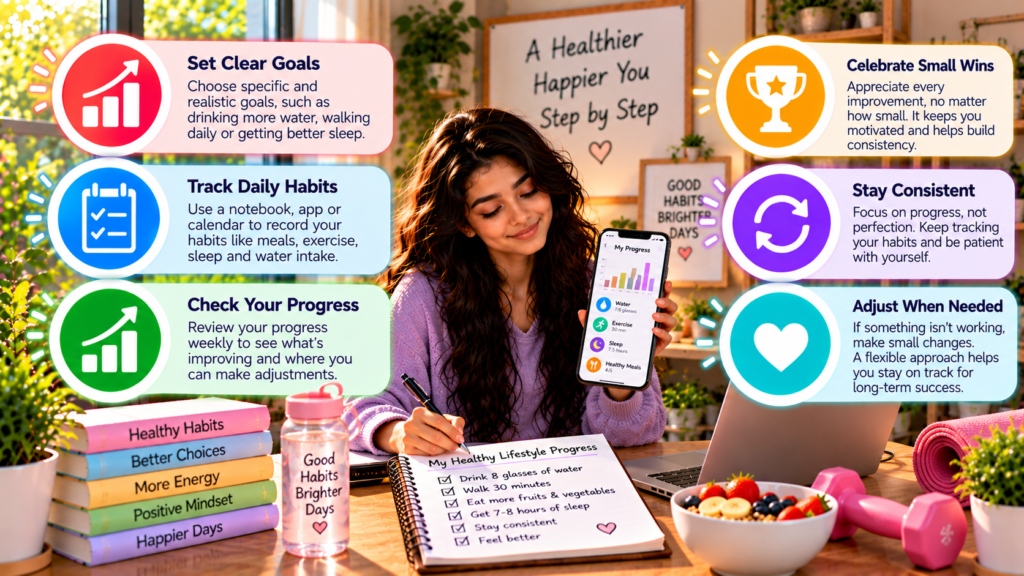
Before tracking your progress, it is important to understand what you want to achieve. Without clear goals, it can be difficult to decide which habits to monitor or how to recognize improvement.
Start by identifying the areas of your lifestyle you would like to develop. You might want to become more physically active, improve your sleep schedule, prepare balanced meals, reduce screen time, or create more opportunities for relaxation.
Try to make each goal specific and realistic. For example, instead of saying that you want to exercise more, you could aim to walk for fifteen minutes on four days each week. Instead of simply wanting to sleep better, you might establish a consistent bedtime on most nights.
Clear goals make tracking easier because you know what actions you are trying to maintain.
It is also helpful to focus on a small number of goals at first. Monitoring too many habits simultaneously can become confusing and time consuming. Once your initial routine becomes manageable, you can introduce additional goals if needed.
2. Create a Daily Habit Tracker
A daily habit tracker is one of the simplest ways to monitor healthy lifestyle progress. It allows you to record whether you completed specific activities without needing complicated calculations or expensive equipment.
You can use a notebook, a printed checklist, a spreadsheet, or a mobile application. The best option is the one you can use consistently.
For example, your daily habit tracker might include:
- Drinking water regularly throughout the day.
- Eating fruits and vegetables.
- Completing planned physical activity.
- Taking breaks from prolonged sitting.
- Following a relaxing evening routine.
- Going to bed at a consistent time.
- Spending a few minutes outdoors.
At the end of each day, mark the habits you completed. You can also add a short note about anything that affected your routine.
Remember that the purpose of a habit tracker is to provide useful information, not to create a perfect record. If you miss a habit on a particular day, simply record it honestly and continue with your plan.
Over time, your tracker can help you recognize patterns and understand which habits are becoming easier to maintain.
3. Monitor Your Physical Activity
Regular movement is an important part of a healthy lifestyle. Tracking physical activity can help you understand how often you move, which activities you enjoy, and whether your routine fits your goals.
You do not need to measure every movement throughout the day. Begin by recording activities that are relevant to your personal plan.
For example, you might record the number of walks completed each week, the time spent cycling, or the number of exercise sessions you finished.
A simple activity log could include the date, activity, duration, and a brief note about how you felt afterward.
If you are beginning a fitness routine, focus on building consistency before worrying about performance. Completing several comfortable walks each week may be more useful than setting an ambitious target that is difficult to maintain.
As your routine develops, you can adjust the duration or intensity according to your ability and comfort.
Fitness trackers and smartphone applications can also record steps, movement time, and other activity information. These tools can be helpful, but their measurements are estimates and should not be treated as perfect indicators of health.
Choose an activity level that suits your circumstances, and seek professional guidance if you have health concerns that affect exercise.
4. Track Your Eating Habits Without Overcomplicating Them
Food choices are another important area to consider when tracking healthy lifestyle progress. Rather than focusing only on calories or body weight, you can pay attention to the overall quality and variety of your meals.
For example, you might record whether your meals include vegetables, fruits, whole grains, protein sources, and other foods that support a balanced diet.
A simple food journal can help you understand your regular eating patterns. You may notice that you often skip breakfast, rely on convenience foods when busy, or have limited variety in your meals.
These observations can help you identify practical improvements.
If you frequently skip meals because you have little time, preparing simple options in advance might help. If you rarely eat vegetables, you could start by adding them to lunch or dinner.
It is not necessary for every meal to be perfect. Food preferences, cultural traditions, budgets, and access to ingredients all influence eating habits.
Try to use food tracking as a way to understand your choices rather than judge them. If detailed food logging makes you anxious or encourages restrictive eating, a simpler habit based approach may be more appropriate.
5. Keep a Record of Your Sleep Routine
Sleep plays an important role in everyday wellbeing, energy levels, concentration, and recovery. Monitoring your sleep routine can help you identify habits that may be affecting the quality of your rest.
You can begin by recording your bedtime, wake up time, and general feelings of restfulness in the morning.
For example, you may notice that you feel more refreshed when you follow a consistent schedule. You might also discover that late night screen use or irregular working hours make it harder to settle down.
A sleep journal does not need to be detailed. A few notes each morning can provide enough information to identify useful patterns.
Consider tracking the following:
- Approximate bedtime and wake up time.
- Whether your schedule was consistent.
- How rested you felt after waking.
- Whether you used screens close to bedtime.
- Any noticeable factors that affected your sleep.
Sleep tracking devices can provide additional estimates, but they cannot measure every aspect of sleep accurately. Your personal experience is also important.
If you regularly experience significant sleep difficulties or persistent daytime tiredness, consider discussing these concerns with a qualified healthcare professional.
6. Notice Changes in Energy and Mood
Healthy lifestyle progress is not always visible through numbers. Sometimes, meaningful changes appear in how you feel throughout the day.
You might notice that you have more energy for everyday activities, feel more organized, or find it easier to manage routine responsibilities. You may also discover that taking regular breaks helps you feel less overwhelmed.
Keeping a brief mood and energy journal can help you recognize these changes.
At the end of each day, write one or two sentences about your general energy, mood, and any habits that may have influenced them. There is no need to rate every emotion or analyze every experience.
For example, you might write that a morning walk helped you feel refreshed or that a busy schedule made it difficult to take breaks.
Over several weeks, these notes may reveal patterns that are not obvious when looking at individual days.
Remember that mood and energy can be affected by many factors, including sleep, work demands, relationships, and physical health. Tracking helps you notice possible connections, but it does not prove that a particular habit caused a specific change.
7. Review Your Progress Every Week
Daily tracking provides information, but weekly reviews help you understand what that information means.
Choose a convenient time each week to look over your records. You might do this on a Sunday evening or whenever you normally plan your upcoming schedule.
Ask yourself a few practical questions. Which habits did I maintain? What made them easier? What interrupted my routine? Did I set realistic expectations? What small change could improve the next week?
For example, if you planned to walk four times but completed two walks, consider why the other sessions did not happen. Perhaps the planned times were inconvenient, or your work schedule changed.
Instead of treating this as failure, use the information to adjust your plan. You might choose shorter walks or move them to a different time of day.
Weekly reviews help you make decisions based on your actual experience rather than relying only on motivation or memory.
They also provide an opportunity to recognize progress. Maintaining a few healthy habits consistently is worth acknowledging, even when other goals still need attention.
8. Use Simple Tools to Make Tracking Easier
You do not need to purchase special equipment to track healthy lifestyle progress. Many useful methods are free or already available in your home.
A notebook is a good choice if you prefer writing things down. It allows you to record habits, observations, and personal reflections without digital distractions.
A calendar can help you mark exercise sessions, planned outdoor activities, or regular bedtime reminders.
A spreadsheet is useful if you prefer organizing information into rows and columns. You can create separate sections for activity, sleep, meals, and other habits.
Mobile applications may offer reminders, progress charts, and automatic activity records. Some smartwatches and fitness bands can also estimate daily movement and sleep patterns.
When choosing a digital tool, consider privacy, ease of use, cost, and whether the features are genuinely helpful.
Avoid collecting more information than you need. A complicated tracking system may become another responsibility rather than a useful support.
The best tool is one that makes it easier to follow your plan without taking too much time away from the activities you are trying to improve.
9. Focus on Consistency Rather Than Perfection
One common mistake when tracking healthy habits is expecting every day to go according to plan. Real life is unpredictable, and there will be days when work, family responsibilities, travel, or tiredness affect your routine.
Missing one workout or having an unplanned meal does not erase your previous progress.
Instead of aiming for a perfect record, focus on returning to your habits when circumstances allow. If you miss your usual walk, you can resume your routine the next day. If your evening schedule changes, you can still aim for a reasonable bedtime.
It may also help to create flexible alternatives for busy days. A shorter walk can replace a longer session when time is limited. A simple homemade meal can be a practical alternative when you cannot prepare your usual recipe.
Consistency means continuing to make reasonable efforts over time. It does not mean following an identical schedule under every circumstance.
By allowing flexibility, you can make healthy habits a more sustainable part of your lifestyle.
10. Avoid Comparing Your Progress With Other People
Everyone begins from a different starting point. People have different schedules, physical abilities, resources, responsibilities, and personal goals.
Comparing your progress with someone else’s fitness records, meal plans, sleep scores, or online achievements may create unnecessary pressure.
For example, another person may have more time for exercise or access to facilities that are not available to you. Their routine may also be designed for goals that differ from your own.
Instead of using someone else’s results as your standard, compare your current habits with your previous habits.
Perhaps you are walking more regularly than last month, preparing meals at home more often, or taking better breaks during the workday. These are meaningful improvements even if they appear modest.
Personal tracking is most useful when it helps you understand your own progress and make decisions that suit your needs.
11. Recognize Non Scale Progress
Some people measure healthy lifestyle progress mainly through body weight. Although weight may be relevant to certain personal or medical goals, it is only one possible measurement and does not provide a complete picture of wellbeing.
Many positive changes are not reflected on a scale.
You may find it easier to complete everyday activities, maintain a regular sleep schedule, prepare balanced meals, or make time for relaxation. You might also notice improvements in your exercise consistency, flexibility, or ability to organize your day.
These changes can be recorded through habit logs, personal notes, and practical observations.
If you choose to monitor body weight for a specific reason, remember that it can fluctuate naturally. Avoid making conclusions from a single measurement, and consider professional guidance when weight monitoring is part of a medical plan.
A balanced approach focuses on a variety of indicators rather than treating one number as the definition of success.
12. Adjust Your Goals as Your Lifestyle Changes
Your needs and responsibilities may change over time. A routine that works during a quiet month may become difficult when work increases or family commitments change.
For this reason, reviewing and adjusting your goals is an important part of long term progress.
If your current plan is too demanding, reduce the number of habits you are tracking or make individual goals more manageable. If a habit has become consistent and comfortable, you may decide to develop it further.
For example, you could begin with short walks three times a week and gradually increase their duration if you feel comfortable. Alternatively, you might replace an activity you dislike with another form of movement that better suits your preferences.
There is no requirement to improve every habit continuously. Maintaining a useful routine can be an achievement in itself.
Your tracking system should support your life, not control it. If recording every detail becomes stressful, simplify the process and focus on the habits that matter most.
Conclusion
Tracking your healthy lifestyle progress is a practical way to understand your habits, recognize improvements, and identify areas that need attention. By setting clear goals, keeping a simple habit tracker, monitoring physical activity and sleep, and reviewing your experiences regularly, you can make more informed decisions about your daily routine.
In my view, the most useful approach is to focus on small actions that you can repeat consistently. You do not need expensive devices, complicated spreadsheets, or perfect daily records to make progress.
Start with two or three habits that matter to you, choose a simple tracking method, and review your results each week. Celebrate meaningful improvements and adjust your plan when your circumstances change.
A healthy lifestyle is not a short term project with a final finish line. It is an ongoing process of learning, adapting, and making choices that support your general wellbeing. By tracking progress in a balanced way, you can stay aware of your efforts and build habits that are more realistic and sustainable over time.