Reading food labels is an important skill that can help us make better decisions about what we eat every day. Many packaged foods look healthy at first glance, but their nutritional value can vary significantly. Some products contain useful nutrients, while others may have high amounts of added sugar, sodium, or saturated fat. By learning how to read food labels, we can compare products, understand their ingredients, and choose foods that better support our nutritional needs.
In my opinion, healthy eating is not only about choosing fresh fruits and vegetables. It is also about understanding the foods we purchase from grocery stores and supermarkets. Packaged foods can be convenient, affordable, and nutritious when we know what to look for.
Food labels provide important information about serving sizes, calories, protein, carbohydrates, fats, vitamins, minerals, and ingredients. Although the information may seem confusing at first, understanding a few key sections can make shopping much easier.
In this guide, I will explain how to read food labels for better nutrition, what details deserve the most attention, and how to compare products without making grocery shopping complicated.
What Is a Food Label?
A food label is the information printed on a packaged food product to help consumers understand its contents and nutritional value. Depending on the country and product, a label may include a nutrition facts panel, ingredient list, serving size, allergen information, expiration or best before date, and storage instructions.
Food labels are useful because they allow us to evaluate products before purchasing them. For example, when comparing two breakfast cereals, we can check their fiber content, added sugars, serving sizes, and ingredients rather than choosing only the product with the most attractive packaging.
The information on labels can also help people manage specific dietary needs, such as reducing sodium intake, increasing fiber, or avoiding an ingredient that causes an allergic reaction.
However, food labels should be read carefully. Words such as natural, light, multigrain, and healthy do not automatically mean that a product is the most nutritious choice.
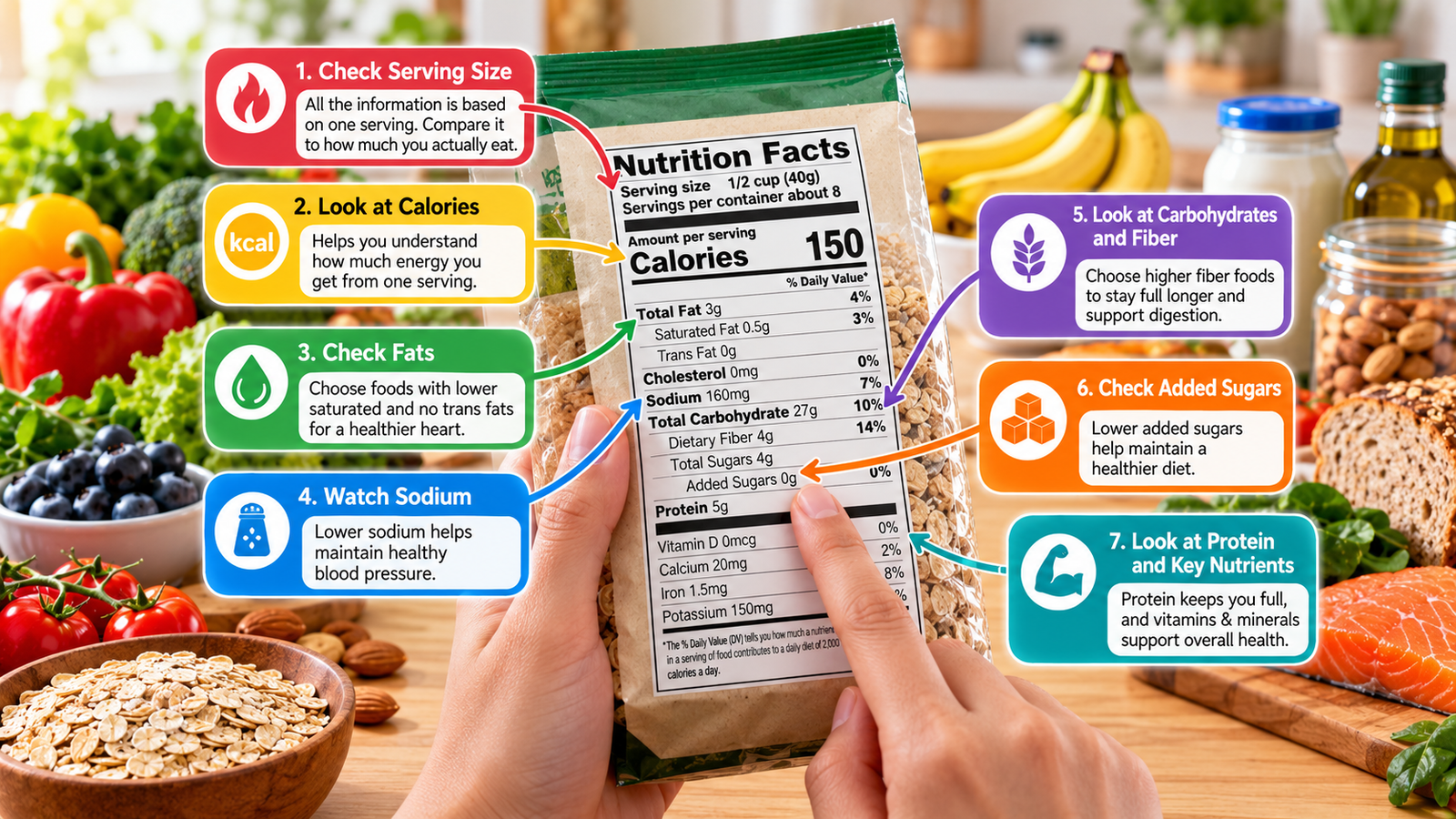
1. Check the Serving Size First
One of the first things I recommend checking on a food label is the serving size. This information tells you the amount of food used to calculate the nutritional values listed on the package.
For example, a packet of crackers might contain two servings, even though someone could easily eat the entire packet at once. If the label lists 150 calories per serving, eating two servings would provide 300 calories.
The same principle applies to sugar, sodium, protein, carbohydrates, and fats. If you consume twice the listed serving size, you generally consume twice the listed nutrients.
It is also important to distinguish between a serving size and the amount you should eat. A serving size is a reference used for the label, not necessarily a recommendation for every individual.
When reading food labels, consider how much you normally eat. This helps you understand the nutritional value of a realistic portion instead of relying only on the numbers printed on the package.
2. Understand Calories and Energy
Calories measure the energy provided by food. Your body needs energy for breathing, movement, digestion, maintaining body temperature, and other normal functions.
The number of calories you need each day depends on factors such as age, body size, physical activity, and individual health needs.
When checking a food label, look at the calories per serving and compare them with the amount you expect to eat. This can be useful when choosing between similar products.
For example, two snack bars may look almost identical, but one might provide substantially more energy because it contains more added fats or sugars. Neither number alone determines whether the product is healthy, but it provides useful information.
I believe calories should be considered alongside other nutritional details. A food with more calories may also provide protein, fiber, vitamins, and minerals. Meanwhile, a lower calorie product may contain little nutritional value.
Instead of judging a food only by its calorie count, consider the complete nutrition label and how the product fits into your overall eating pattern.
3. Pay Attention to Added Sugar
Sugar is an important part of food label reading, especially when choosing breakfast cereals, flavored yogurt, sweetened drinks, biscuits, sauces, and packaged snacks.
Many products contain naturally occurring sugars as well as added sugars. For example, plain milk contains naturally occurring lactose, while sweetened yogurt may contain additional sugar.
When a label lists added sugars separately, this information can help you identify how much sugar has been added during manufacturing or preparation.
High intake of added sugars can make it harder to maintain a balanced diet, particularly when sugary products replace foods that provide more essential nutrients.
Look for added sugars in the nutrition panel when the information is available. You can also review the ingredient list for terms such as sugar, glucose syrup, fructose, dextrose, honey, and other sweetening ingredients.
Remember that ingredients such as honey and syrups still contribute added sugars when used to sweeten a packaged product.
You do not need to avoid every product containing sugar. Instead, compare similar options and choose products with less added sugar when practical.
For example, plain yogurt with fresh fruit may be a useful alternative to heavily sweetened flavored yogurt.
4. Check Sodium and Salt Content
Sodium is an essential mineral that helps the body maintain fluid balance and supports normal nerve and muscle function. However, consuming too much sodium over time can contribute to high blood pressure in some people.
Packaged foods can contain significant amounts of sodium, even when they do not taste especially salty. Common examples include instant noodles, processed meats, packaged soups, salty snacks, sauces, and seasoning mixes.
When comparing products, check the sodium amount per serving. If one label lists salt instead of sodium, remember that these are not the same measurement.
Salt is made primarily of sodium chloride. As a rough guide, 1 gram of salt contains about 400 milligrams of sodium.
The World Health Organization recommends that adults consume less than 2,000 milligrams of sodium per day, equivalent to less than 5 grams of salt. Individual medical needs may differ, so people with specific health conditions should follow appropriate professional guidance.
A practical way to reduce sodium intake is to compare similar packaged foods and choose lower sodium options when available. You can also add flavor at home with garlic, lemon juice, herbs, and spices instead of relying entirely on salt.
5. Understand Total Fat and Different Types of Fat
Food labels often list total fat, saturated fat, and sometimes trans fat. Understanding these categories helps you compare products more effectively.
Total fat includes the different types of fat present in a food. Fat provides energy, helps the body absorb certain vitamins, and supports normal cell functions.
Unsaturated fats are found in foods such as nuts, seeds, avocados, and many vegetable oils. Replacing some saturated fats with unsaturated fats can support heart health.
Saturated fat is found in foods such as butter, fatty meats, and some packaged products. Consuming excessive amounts can contribute to higher LDL cholesterol levels.
Trans fats, particularly industrially produced trans fats, are associated with increased cardiovascular risk. Their use has been restricted or eliminated in many places, but ingredient checking can still be useful where regulations and products vary.
When comparing packaged foods, consider the amount of saturated fat and the overall nutritional value of the product. A food should not automatically be considered unhealthy simply because it contains fat.
For example, nuts contain fat but also provide protein, fiber, and several minerals. The goal is to understand the type of fat and the role the food plays in your overall diet.
6. Look at Protein Content
Protein helps build and repair body tissues and supports normal muscle function. It is also involved in the production of enzymes and other substances needed by the body.
Food labels can help you identify products that contribute protein to your daily meals. Common sources include eggs, dairy products, beans, lentils, fish, chicken, nuts, seeds, and soy products.
When choosing packaged foods, protein content can be particularly useful when comparing products such as yogurt, breakfast cereals, bread, and snack bars.
However, a product containing a large amount of protein is not automatically the healthiest option. Some high protein snacks may also contain considerable added sugar, sodium, or saturated fat.
I recommend looking at the entire label instead of choosing a product based on protein alone.
For everyday meals, you can also obtain protein from affordable foods such as eggs, lentils, chickpeas, and beans rather than relying on specialized protein products.
7. Choose Foods With More Dietary Fiber
Dietary fiber supports digestive health and helps maintain regular bowel movements. Certain types of fiber can also help manage blood cholesterol and support healthy blood glucose levels.
Good sources include whole grains, beans, lentils, vegetables, fruits, nuts, and seeds.
When reading food labels, fiber content can be especially useful when comparing breakfast cereals, breads, crackers, and other grain based products.
For example, two loaves of bread may have similar calorie counts, but the whole grain option may provide more fiber than the refined grain alternative.
Check the ingredient list as well. Ingredients such as whole wheat, oats, and other whole grains near the beginning of the list can indicate that they make up a substantial portion of the product.
Terms such as multigrain do not necessarily mean that a food is made mostly from whole grains. A multigrain product may contain several refined grains, so it is worth checking the actual ingredients.
If you want to increase your fiber intake, make gradual changes and drink enough water to help your digestive system adjust.
8. Read the Ingredient List Carefully
The nutrition facts panel provides numerical information, while the ingredient list tells you what the food is made from.
Ingredients are generally listed in descending order by weight. This means the ingredient present in the greatest amount usually appears first, followed by the others.
For example, if sugar appears near the beginning of a cereal’s ingredient list, it may be a major component of that product.
The ingredient list can also help you identify whole grains, oils, sweeteners, preservatives, flavorings, and potential allergens.
Some ingredient names may seem unfamiliar, but unfamiliar does not automatically mean harmful. Many food additives are used for specific purposes, such as preserving freshness, maintaining texture, or preventing separation.
Rather than avoiding every product with a long ingredient list, focus on the information that matters for your needs.
If you have a food allergy, carefully check the allergen declaration and ingredient list every time you purchase a product. Formulations can change, and precaution is important even if you have bought the product before.
9. Do Not Rely Only on Front Package Claims
Food packaging often uses phrases such as natural, low fat, sugar free, high protein, organic, or whole grain. These claims may provide useful information, but they do not tell you everything about a product’s nutritional value.
For example, a low fat snack may contain substantial added sugar. A sugar free product may still contain considerable calories or saturated fat. A product labeled natural may not necessarily contain more fiber or vitamins than another option.
Similarly, organic describes a production standard rather than guaranteeing that a food is lower in sugar, salt, or calories.
I recommend using front package claims as a starting point rather than making the final decision based on them.
Turn the package over and examine the serving size, nutrition panel, and ingredients. This gives you a more complete picture of what you are buying.
It is also useful to compare products within the same category. Comparing two breakfast cereals is usually more informative than comparing cereal with an unrelated food.
10. Understand Percent Daily Value
Some nutrition labels include a percentage of Daily Value, sometimes written as %DV. This number indicates how much a serving contributes to a reference daily amount of a particular nutrient.
For example, a product might provide 15% of the Daily Value for a nutrient in one serving. This means that the serving supplies 15% of the reference amount used for that label.
In systems that use the common United States label guide, 5% Daily Value or less is generally considered low, while 20% or more is generally considered high. These are convenient guidelines for many nutrients, but they are not universal rules for every nutrient or every country’s labeling system.
A higher percentage can be useful for nutrients you want to obtain more of, such as fiber, while a lower percentage may be preferable for nutrients you are trying to limit, such as sodium or saturated fat.
Daily Value figures are reference points rather than personalized recommendations. Your individual nutritional requirements may be different.
If the food label in your country does not include percentages, you can still compare the actual amounts per serving or per 100 grams.
11. Compare Similar Products Before Buying
One of the easiest ways to use food labels is to compare two or three similar products before choosing one.
Suppose you want to buy breakfast cereal. Instead of choosing the package with the healthiest sounding name, compare the serving size, fiber, added sugars, sodium, and ingredient list.
You can use the same method for bread, yogurt, canned foods, snacks, and sauces.
When comparing products, make sure the serving sizes are similar. If they differ significantly, compare the values per 100 grams when available. This can provide a more consistent basis for comparison.
You do not need to find a perfect product. Focus on choosing an option that better matches your needs and preferences.
For example, if you want to increase fiber intake, prioritize products with more fiber. If you are reducing sodium, compare sodium amounts. If you need to avoid an allergen, check the ingredient and allergen information first.
This simple approach makes grocery shopping more practical and less confusing.
12. Check Dates and Storage Instructions
Nutrition is important, but food safety matters too. Food labels may include a best before date, use by date, expiration date, or storage instructions, depending on the product and local regulations.
A best before date often relates to expected quality, while a use by or expiration date may have specific safety implications depending on the food and jurisdiction. The wording should be interpreted according to local guidance.
Check whether the product needs refrigeration after opening and how long it can be stored. Some foods also require special handling after preparation.
Avoid purchasing damaged or leaking packages, and do not rely on smell or appearance alone to determine whether a food is safe.
Reading storage instructions helps preserve food quality and reduce the risk of foodborne illness.
Common Food Label Reading Mistakes
A few common mistakes can make food label reading less useful.
Focusing only on calories: Calories matter, but protein, fiber, fats, sodium, added sugar, and overall food quality also deserve attention.
Ignoring serving sizes: The nutrition information may apply to only part of the package.
Trusting every health claim: Words on the front of a package do not replace the nutrition panel or ingredient list.
Assuming all fats are unhealthy: The type of fat and the overall food source matter.
Avoiding every unfamiliar ingredient: An unfamiliar ingredient is not automatically dangerous. Consider its purpose and the overall product.
Comparing unrelated foods: Compare similar products and use consistent serving sizes whenever possible.
Avoiding these mistakes can help you make more informed choices without spending too much time in the supermarket.
Conclusion
Learning how to read food labels for better nutrition can make everyday grocery shopping easier and help you choose foods that fit your dietary needs. By checking serving sizes, calories, added sugars, sodium, fats, protein, fiber, and ingredient lists, you can better understand the products you purchase.
I believe the best approach is to focus on a few important details at a time rather than trying to analyze every number on every package. Start by comparing similar products, checking for added sugars and sodium, and looking for useful sources of fiber and protein.
Remember that no single number or label claim determines whether a food is healthy. The overall quality of your diet, your portion sizes, and your individual nutritional needs all matter.
With regular practice, food labels become easier to understand. This simple skill can help you make thoughtful food choices, build balanced meals, and develop healthier eating habits over time.